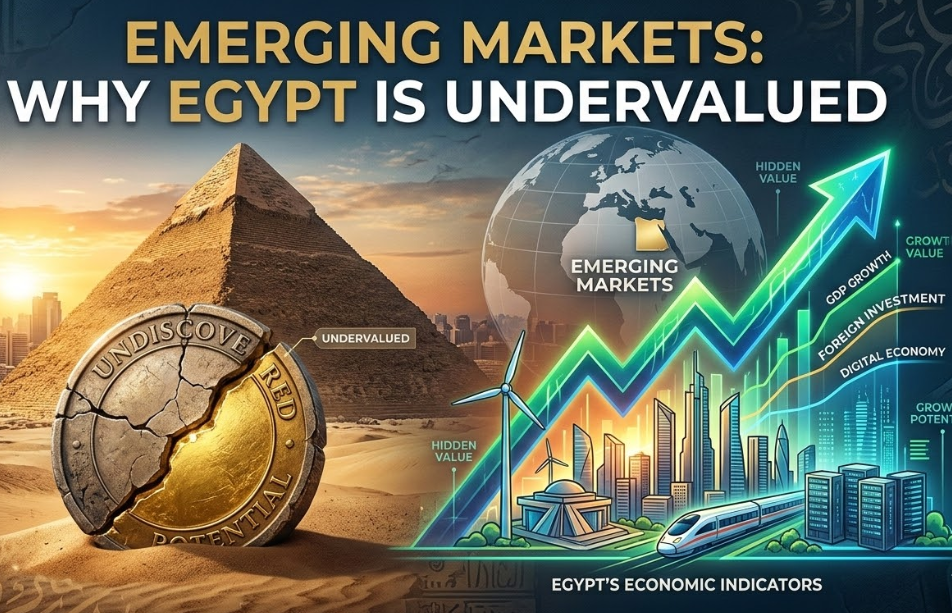
Global capital is undergoing a historic reallocation as the macroeconomic cycle shifts. Consequently, investors are searching for undervalued economies that offer resilience and structural growth. In this shifting landscape, the Egypt emerging market presents a compelling value proposition. While developed nations face slowing growth, emerging economies are projected to expand robustly. For global funds exploring investing in Egypt through Emerald’s Edition, the current climate offers a unique entry point.
Following severe macroeconomic adjustments and currency devaluations, the nation is operating as a rising investment destination with a V-shaped recovery trajectory. Supported by sweeping privatization mandates and a deeply discounted equity market, Egypt investment opportunities are expanding rapidly. Ultimately, this ensures robust Egypt economy growth, positioning the country to capture significant Egypt foreign investment over the next decade.
Egypt’s Strategic Location in Global Trade
- Geographical coordinates have historically served as the foundation of the nation’s geopolitical and economic power.
- Therefore, the country effortlessly connects the consumer markets of Europe with the resource-rich expanses of Africa and the industrial powerhouses of Asia.
- In the contemporary era, this role connecting Africa, Europe, and Asia is viewed as a critical instrument of global economic security.
- Furthermore, the Suez Canal remains the undisputed artery of global maritime logistics, historically handling approximately 12 percent of all global trade.
- Following targeted diplomatic breakthroughs, maritime traffic initiated a vigorous rebound by early 2026, recording massive revenues and underscoring the permanent return of global carriers to this vital maritime corridor.
- Moreover, the modern shipping and logistics advantages extend far beyond the collection of transit tolls to the massive Suez Canal Economic Zone.
- This zone spans 455 square kilometers and comprises four integrated industrial zones alongside six deep-water seaports.
- Consequently, this infrastructure is transforming the nation into a premier regional hub for heavy manufacturing and re-export activities.
- The financial and regulatory architecture is explicitly engineered to capture foreign capital, offering a 50 percent reduction in the corporate tax rate and allowing full foreign ownership without restrictions on profit repatriation.
- By integrating world-class utilities with streamlined services, the global trade routes passing through the country are seamlessly integrated with local manufacturing.
Economic Reforms Transforming Egypt’s Investment Climate
- The narrative surrounding the economic resurgence is deeply tied to profound structural reforms implemented recently in cooperation with the International Monetary Fund.
- Responding to previous domestic economic crises, the government engineered a radical orthodox pivot in its macroeconomic policy.
- This policy was anchored by a massive Extended Fund Facility and a Resilience and Sustainability Facility.
- Therefore, the state committed to complete exchange rate liberalization, aggressive monetary tightening, and a comprehensive overhaul of its state-owned commercial footprint.
- The most pivotal transformation reshaping the investment climate involves the state’s aggressive privatization programs.
- To illustrate, the government forcefully re-initiated the process by transferring highly competitive state-owned companies directly to the Sovereign Fund of Egypt.
- By moving major assets under the commercial mandate of the sovereign wealth fund, the government is shifting control to a profit-driven management structure designed to secure high-value strategic partnerships.
- Parallel to these structural reforms, regulatory modernization is sweeping through the government apparatus, focusing primarily on dismantling everyday bureaucratic friction.
- Key regulatory overhauls include the digitization of corporate actions to streamline capital increases and company establishment.
- Moreover, authorities are finalizing systems to allow foreign investors to establish companies remotely utilizing digital signatures and electronic passports.
- Additionally, the government has passed sweeping legislation providing massive tax breaks and simplified record-keeping for small and medium-sized enterprises.
Massive Infrastructure Projects Driving Growth
-

Emerging Markets: Why Egypt Is Undervalued Infrastructure is the physical manifestation of economic ambition, and the country is currently executing one of the most aggressive infrastructure buildouts in modern history.
- These mega-projects span thousands of kilometers of highways, deep-water ports, railways, and smart cities.
- Consequently, they are positioning the nation as an unavoidable node in global supply chains.
- The crown jewel of this logistical overhaul is the massive high-speed electric rail network, which spans 2000 kilometers and connects 60 cities from the Red Sea directly to the Mediterranean Coast.
- Crucially, this rail network integrates passenger transit with heavy freight capacity, engineered to handle massive volumes of freight annually.
- As a result, this network drastically slashes freight transit times, lowers domestic logistics costs, and provides an overland failsafe against maritime disruptions.
- Simultaneously, the urban geography is being redefined through the construction of the New Administrative Capital.
- This sprawling digitized metropolis currently houses government ministries, the parliament, and the central bank.
- The city is fundamentally designed to attract vast tranches of foreign direct investment by offering flawless corporate infrastructure.
- Furthermore, establishing a special administrative province allows the state to bypass legacy municipal bureaucracy, creating an ultra-efficient jurisdiction custom-built for multinational corporations.
- Ultimately, this immense commitment explains exactly how infrastructure attracts foreign investment by permanently lowering the operational barriers to entry for global firms.

Egypt’s Demographic Advantage
- While infrastructure provides the skeleton of an economy, demographics provide its lifeblood, practically guaranteeing long-term domestic consumption growth.
- By 2026, the population exceeded 120 million people, cementing its status as the most populous nation in the Middle East and the third most populous on the African continent.
- The structural composition of this population holds true economic value, with an exceptionally young median age of 24 years.
- This metric translates into a continuously expanding energetic young workforce and an inherently aggressive consumer market.
- Moreover, with a high urbanization rate, the country offers consumer facing multinationals immediate scalable access to a massive buyer base.
- This demographic dividend provides a dual advantage for international investors operating within the broader Middle East and North Africa region.
- First, it ensures an abundant cost-competitive labor pool that is critical for labor-intensive manufacturing and technology-outsourcing operations.
- Second, the sheer volume of new household formations drives perpetual demand across essential expanding consumer market sectors, such as residential real estate, consumer finance, and healthcare.
Top Investment Sectors in Egypt
- The convergence of macroeconomic reform, infrastructure development, and demographic pressure answers the question of why invest in Egypt by unlocking highly scalable sectors.
- Renewable Energy: The nation is rapidly positioning itself as a hemispheric superpower in green energy, driven by optimal solar irradiance and high wind speeds. The government has revised its renewable energy targets to comprise over 40 percent of the national power mix by 2030. This sector is supported by international Power Purchase Agreements under the Build Own Operate model, which guarantees utility-scale returns.
- Tourism: The tourism sector is experiencing a renaissance fueled by infrastructure upgrades and strategic luxury developments. Consequently, the country is welcoming millions of tourists and expecting robust revenue growth throughout the decade.
- Real Estate: The real estate market operates as a primary store of value and an increasingly attractive arbitrage opportunity for foreign investors. Furthermore, the government has heavily incentivized this sector by relaxing foreign ownership laws.
- Logistics and Manufacturing: The modernization of port infrastructure presents turnkey operations for heavy manufacturing. The state is actively targeting the localization of automotive components and textiles through lucrative tax holidays.
- Fintech: The unbanked nature of a significant portion of the population has birthed a highly profitable fintech ecosystem, presenting tremendous business opportunities in Egypt. Companies operating in digital payments and consumer credit are scaling at venture-backed speeds.
Egypt’s Startup Ecosystem Is Accelerating
-

Emerging Markets: Why Egypt Is Undervalued Long considered the intellectual and cultural capital of the Arab world, Cairo is rapidly evolving into the premier technology and venture capital hub of North Africa.
- The ecosystem is maturing beyond early-stage ideation into deep-tech growth-stage operations, demonstrating remarkable counter-cyclical resilience.
- In recent years, startups have successfully secured hundreds of millions in equity and debt financing, representing massive year-over-year increases.
- This liquidity is distributed across dozens of venture capital deals, highlighting the underlying depth of the market and a strategic shift toward institutional debt.
- Protech, fintech innovation, and digital transformation are the primary drivers of this sustained venture capital growth.
- Recognizing the strategic importance of technology, the government launched a monumental state commitment designed to act as a non-volatile market floor.
- This initiative directly mitigates investor caution related to currency risks and bureaucratic friction.
- Furthermore, to bridge the critical growth capital gap, the Sovereign Fund of Egypt is establishing a dedicated co-investment vehicle to partner alongside venture capital firms.
- Ultimately, this synthesis of public-private collaboration cements the country’s position as a mandatory allocation for funds investing in Africa Egypt.

Trade Agreements Unlock Access to Global Markets
- Investing in the country is fundamentally an investment in borderless market access.
- This geographic advantage is legally codified through a sophisticated web of over 100 bilateral and multilateral trade agreements.
- Consequently, these agreements grant frictionless access to more than 2 billion consumers across Africa, Europe, and the Middle East.
- For global corporations targeting the African continent, central participation in the African Continental Free Trade Area is a structural game changer that promises to boost cross border trade massively.
- However, as the European Union fully phases in the Carbon Border Adjustment Mechanism, many nations relying heavily on fossil fuels face severe export bottlenecks.
- Therefore, the nation provides the ultimate geopolitical and environmental arbitrage.
- By localizing manufacturing within economic zones powered by green hydrogen infrastructure, multinational corporations can export to Europe without incurring carbon penalties.
- Additionally, Qualitative Industrial Zone agreements allow duty-free access to the United States for goods with specific content requirements.
- This comprehensive regulatory architecture allows global capital to utilize the nation as a highly diversified export launchpad.
Risks Investors Should Consider
- A nuanced evaluation of any emerging market requires a transparent balanced analysis of the structural and exogenous risks that accompany its high-yield environment.
- Inflation and Currency Volatility: Following the floating of the pound to secure international funding, the country experienced severe inflationary shocks. However, the lagged effects of aggressive central bank rate hikes have successfully broken the inflationary fever, leading to rapidly cooling inflation rates.
- Regulatory Complexity: Despite aggressive recent reforms, legacy regulatory complexity and bureaucratic friction remain hurdles. Although the new investment ministry is deploying rapid digitization strategies, the execution risk of implementing cultural reform within the broader civil service requires careful navigation.
- Geopolitical Risks: The nation sits in a highly volatile geopolitical neighborhood, carrying inherent risks from regional proxy conflicts. Nevertheless, the rapid recovery of maritime revenues following localized ceasefires proves its remarkable ability to maintain sovereign security and critical infrastructure resilience.
Egypt’s Role in the Next Emerging Market Boom
- Looking toward the remainder of the decade, macroeconomic indicators suggest that asset classes are trading at profound historical discounts.
- These assets are primed for a massive repricing event, driven by long-term economic potential and regional leadership.
- The equity market provides the most vivid illustration of this undervaluation, yielding a price to earnings ratio that represents a striking value proposition when juxtaposed against global peers.
- Furthermore, global asset allocators are increasingly bullish on sovereign debt, attracted by high-carry yields as global inflation cools.
- The government’s success in driving down its general budget debt validates the credibility of its fiscal consolidation.
- Growing foreign direct investment serves as the ultimate leading indicator of economic confidence.
- As structural reforms take deep root, privatization accelerates, and infrastructural mega projects come online, this massive capital influx will inevitably compound.